
My deepest thanks for the invitation.
| Sun | Mon | Tue | Wed | Thu | Fri | Sat |
|---|---|---|---|---|---|---|
| 1 | 2 | 3 | 4 | |||
| 5 | 6 | 7 | 8 | 9 | 10 | 11 |
| 12 | 13 | 14 | 15 | 16 | 17 | 18 |
| 19 | 20 | 21 | 22 | 23 | 24 | 25 |
| 26 | 27 | 28 | 29 | 30 | 31 |


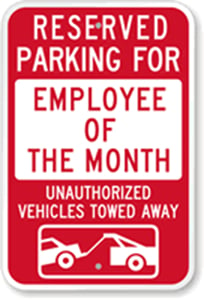 Employee of the Month Reserved Parking Sign (Photo credits: myparkingsign.com)
If you own and operate a small business and there's is a signature stamp with your name on it that enables others to sign checks on your behalf -- find it now and destroy it. Do not rest until this is done.
Do it before it destroys you. The small business signature stamp will save you time in the short term and cost you money in the long term. Potentially, a lot of money. I can attribute $50k of losses through the years to signature stamps. It isn't that they employees in possession of the stamp aren't responsible, they are responsible they just don't care as much as you do about the money coming in and money going out of the business. And they will never care as much as you about the business as you do. Accept it, embrace it and absolutely live it.
The drop off of commitment between owner and employee will always be there. It is just most likely to be expensive with a signature stamp around. But it is prevalent in all tasks that were once done by the owner and are now transitioned to an employee. One needs to be careful about what one hands over and especially hesitant to let important things completely go.

This is short, entertaining and wonderfully insightful. Plus, it has the number one instruction for the lean start up method -- "Get out of the building".

This is an advertisement from CrowdTapp. One has to love the archetypes presented herein. I've met them all many, many times.

I've been involved with the College of Business at James Madison University for 13+ years. It has been a wonderful time. And one in which the College has received great recognition. The 2 minute video below hightlights that progress and the school's Dean during that period.
Congrats to Dean Reid on a job well done.
 Wilson Hall at James Madison University quad in Harrisonburg, VA, United States. Created by User:Alma mater May 3, 2006 with GFDL lisence allows anyone to use this picture for any purposes. (Photo credit: Wikipedia

As a former entrepreneur, now on the “dark side” of Venture Capital for the last ten years; here are 10 lessons I got from the investment side of that experience . These lessons still serve me well on a daily basis.
1. Price doesn’t really matter
 Image via Wikipedia
If a deal works out, the price was right at some level. Get in good deals, and forget about getting the last dollar in a negotiation for that good deal. If the venture fails, whatever you paid was too much. Yes, in the event of success, you would have made more if you paid less… but that is always true of successful investments.
2. Management is everything
Great management will make the right pivots at the right time. The talent, drive and vision of the management team will determine success or failure. If you’re looking at a great idea, if it’s paired with poor management…run.
3. Never pursue a small idea
It is no safer, no easier and much less rewarding to pursue a small idea rather than a big idea.. What’s the point in trying to change the neighborhood when you can change the world. Small ideas struggle to find their way, so do larger ones, so you might as well be working on the large idea. Small ideas are never worth the trouble.
4. You are not a rock star and never will be one as an investor
The entrepreneurs are the stars and they always will be the stars. If you want to be a star go be an entrepreneur. If you’re an investor, work to make your entrepreneur a rock star. Enable their success and enlist recognition for them and what they’re doing.
5. If you don’t add value outside of board meetings, you’re not adding value
The board meeting is a stilted environment for contribution. If you can’t establish yourself as a worthy advisor outside the board meeting, you’re likely not one in it.
6. Don’t invest in people who ignore good advice
Some people have a world class talent for ignoring good advice. Many of them end up as self employed entrepreneurs . Those kinds of entrepreneurs are not worth investing in. Great people and great business people are more open to alternate points of view. Invest in bright people who don’t or won’t ignore good advice.
7. Try to win in the long term….not the short term
If you strike deals which over time prove unfavorable to the other side, your opponents (and they will view themselves as such) will be motivated to screw you. And they will usually succeed at doing so. Strike agreements that are good now and still fair later.
8. Never panic
There are few things uglier than a scared venture capitalist. Don’t ever be anxious to the point that anyone notices. Sometimes slow and steady wins the race. Not many good decisions are made based on fear, especially business decisions.
9. Be nice to people; it pays well
 Image via Wikipedia
Most of the better deal flow comes from people who like me better than my venture capital competitors. Why me and not them? I strive to treat everyone with respect. (I’m sure it’s that and not my jokes…) Be nice to people. It pays off every day.
10. Great deals tend to be great already
In ten years in the VC business, other VC’s haven’t really ever asked me to look at anything other than their dog deals. The great deals are out there but you are going to have to find them yourself. The good news is that they are great deals already. The challenge is to recognize that.
When I started in Venture Capital, my firm directed me to create “proprietary deal flow” which was a term that I didn’t initially comprehend the meaning of. Proprietary deal flow refers to development of a deal pipeline that contains opportunities not seen by others. Today, ten years on, I have pretty good proprietary deal flow. To create that proprietary deal flow, I needed to internalize the 10 lessons listed here -- which might be summarized as be fair, be a good person and look for good people to back.
This article was originally published on BusinessInsider.com

 Image via Wikipedia
I saw a tweet this afternoon from Dharmesh Shah which offered -- "Entrepreneurs: You get a limited number of chances in life to do something really, really big. Take them." @dharmesh
Boy, is he right about that. I think that thought would resonate with most entrepreneurs. The problem becomes how does one recognize when something is "really, really big"? Many things can appear promising and worth pursuing but aren't really after more is known.
One of the related terms of art in venture capital, that something is a "big idea", refers to this phenomena. The "big idea" term is often confusing to entrepreneurs. What makes an idea a big one? Does that also mean it is a good one? Or, how do you know a big idea when you meet one? And, most importantly, if it is a big idea -- is now the right time for this big idea? (Given that for any big idea, being early is the same as being wrong)
For entrepreneurs and their backers, the only idea worth pursuing is a big one because only big ideas provide outsized returns for the invested capital effort and associated risk. So recognizing the big idea is a critical skill for entrepreneur and investor alike. As Dharmesh Shah points out, you will likely only see so many big ideas in your life, so recognizing them is critical.
And just as critical as recognizing them, one needs to execute/realize the big ideas that are spotted from time to time. In fact, whether a big idea is a good one lies not in the eyes of the beholder but in the hands. A big idea is only good in the hands of a person or team capable of pulling it off. I've seen plenty of presentations about big ideas pursued by teams incapable (in my opinion) of realizing the idea's true potential.
So the essential focus has to be developing an eye for the big idea and skills to determine if identified big ideas are good.
I think the 4 key characteristics of big ideas worth pursuing are the following:
1. Innovative or novel
The big idea is always new. It fills white space. It is by definition not a "me too" idea. There isn't anyone else doing it or those they are doing it, don't do it in similar way. Big ideas will inhabit space that is currently unoccupied by definition. It is an universal improvement upon what is currently done by all the possible solutions. If you can't see the innovation in an idea, it isn't likely to be big.
2. Broadly applicable
One of the surest validations of a big idea is the number and variety of potential applications. In fact, the greater difficulty one has in deciding on the particular industry application, the bigger the idea. If something could be used to improve the economics or operations of most industries, it is, by definition, a big idea. Big ideas have the potential to be ubiquitous, which is part of why they're big ideas. But they are also prompt difficulty in choosing the right path. That difficulty is confirmative in my view. If an idea can change the world, it can change any or many industries. Struggling with where to apply an idea is indicative of it being a big idea.
3. Visible money flow
The idea is close to the existing flow of money or customers or a flow that one can easily imagine existing soon. Big ideas are often simple and dont' require 7 step purchasing processes or complex adoption efforts. Open source software was a big idea. Software that was free until you were sure you wanted it was the essence of easy adoption. You could foresee people paying eventually for software or support of software that provided them with real value even if it was initially free to use. The current payment technologies like Square epitomize a clearly visible flow of money associated with the technology's adoption.
 Image via Wikipedia
4. Industry Formation
A big idea that is well timed leverages the formation a new industry. A clear indicator of the potential of a big idea is that exists in an industry that is showing signs of formation from the moves of "smart money" and strong companies. Yes, this isn't always true and one can find big ideas where no industry is present, but for my money and time, I would always advise to arrive early in newly emergin industries.
Let's use the example of augmented reality. Both Google (Link )with eyeglasses and Microsoft (Link) with contact lenses are working on products to support the adoption and usage of augmented reality. So if you have a big idea in augmented reality that meets the first three characteristics, I would argue that your timing is good based upon the demonstrated agreement of these 2 strong companies. Big ideas drive new industries but the formation of an industry involves many different participants. If you look, you can often see those participants lining up and preparing to join into an emerging industry. The presence of those participants and their implicit agreement about the potential industry is a positive indicator of timing. Google and Microsoft are signaling they think augmented reality is going to happen and happen reasonably soon. Which is a great sign for augmented reality.
Big ideas are transformative to everyone surrounding them. And, for entrepreneurs, few things are as fun to find or do. And remember, if you find one, be sure to come see us here at Grotech. We love big ideas too.

Maybe one day there will be a full, "urban dictionary" for venture capitalists. Until then, I respectfully submit the following 7 terms with definitions for potential inclusion.
1. Dog BoyIt is said that one should know that when you see a car go by with a dog in the front passenger seat (head in or out), that the dog thinks he's driving. A dog boy is a management team member who isn't materially affecting the progression of the enterprise without any knowledge of this ineptitude. Usage as in,"Hey did you meet the C.O.O. at Acme Software? Seems like a complete dog boy". Submitted and included in Urban Dictionary
2. Fluffer
This is the local CEO that periodically and regularly spins up a VC into providing a term sheet for a financing that the CEO will not ultimately pursue to completion. Since both the CEO has a back-able deal and VC's don't make it known to whom they've provided Term Sheets, this can go on for some time. The CEO fluffs for reasons only known to him. As in "Did you hear that Super VC Partners put a term sheet down over at Rocketball? Yes, I am sure they did, but is it signed? That CEO is a total fluffer."
3. Goose ManIt is said that a goose wakes up every day in whole new universe. A goose man is someone who fails to recall previous agreements, verbal or written, and must be reacquainted with them upon each meeting or discussion. This is typically most dramatic as a tactic to change a something at the 11th hour. "I don't recall agreeing to that price, provision or term", he'll say, when is it the central tenet upon which the deal conversation proceeded from it onset."
 Image by Muffet via Flickr
This is a CEO who hears good news or positive feedback when none is present. As in, "The CEO told me that they were going to close a huge deal at Cisco and I spoke to the guy over there at Cisco and he said that he might look at it, he might not look at it, he hadn't decided." Whatever the scenario these ears can hear encouragement, support, purchase intention or imminent good news. Urban Dictionary
5. Monkey Punch
When a CEO or management team attempts to change or "monkey" with previously agreed upon terms at a liquidity event or exit to make them more favorable to the CEO or management. "I know we agreed to the liquidation preference when you provided the critical financing as motivation in a time of greatest need/highest risk for you to take the risk, but now, we think it is unfair to profit so much." This is a tough one to take and always a hard hit without warning.5. Virtual Pass
The confirmation of a recently funded CEO that he neither met or spoke with the VC who just told you at a networking event that he passed on your deal. "Yeah, we met with them and didn't see the value. Glad you did it though." As time passes, and especially if the deal progresses well, the virtual pass tends to have "occurred" early and early in calendar time. So, "we didn't see the value" becomes "it was just to early when we saw it".
7. Wet Shoes
The mal-intentioned congratulations by competitive VC's on a closed deal. "Hey I looked at the deal, peed on its shoes, was it wet when you picked it up?" May also be used as in combination with a Virtual Pass. It is to be clear, it is that not only did they pass - virtually or otherwise -- but they really disliked it when they did so.
8. Faux Genius
The impossibly difficult admission by a competing VC that you did a great deal and your competence must be acknowledged in some way. They will say "We were talking about your deal and how well it is working out and asked each -- 'when did Don become such a genius?' -- I guess we all shouldn't have passed on it."

 English: Sir Winston Churchill. (Photo credit: Wikipedia)
The often posed question is why do start ups fail? One often hears that of undercapitalization, market conditions or events beyond the control of the team.
In my experience, the simple answer is that management is unwilling or unable to make them succeed. And that of those two, the more common is that management is unwilling rather than unable to make the business succeed. It can be a fair trade for someone to be unwilling to work 20 hours a day, seven days a week for something likely to fail. It can also simply be more than someone wants to do.
I would acknowledge that sometimes that unwillingness may have its roots in a lack of adequate investor support.
But the fundamental truth is that the weakening of investor support can often be sourced to doubts about management's commitment to succeed in spite of the odds. Many a successful entrepreneur can point to an entreprise that succeeded upon their "will power" -- a business that might have otherwise failed if it weren't for the simple refusal of the entrepreneur to accept that outcome.
 English: Sir Winston Churchill signature (Photo credit: Wikipedia)

Here is an interesting infographic from Open-Site.org
This graphic was created by Open Site. Org
Here is a Link to Open-Site.Org
 Investment Conference (Photo credit: Salmaan Taseer)
Here they are:
1. We see a lot of ideas, all the time, week in and week out. Most say, if you make an investment in our company, we'll really be able to make progress on all fronts. Some say, we haven't had much money to date, but look at what we have been able to achieve with little money in a small amount of time. People that can make progress without money tend to be the ones who make the most progress when they have money.
2. Our scope and interests are limited. We focus our plans on stage of investment, types of technology and specific geography. We win by staying close to our plans. We won't make an exception for you because any off plan successes are considered luck. Any off plan failures make us look stupid.
3. Market timing can be the most important factor in success. More important than management or product. Again, not all the time is this true. But, if you're late, we are likely to consider it game over.
4. We're in a hurry to produce returns but not necessarily in a hurry to invest as we need to be careful. Careful in a number of ways including your idea, team and timing. Your need for the money right now isn't often a factor in our investment process. Repeating that you need the money now frequently, doesn't change that.
5. Sometimes, you may need to consider that your storyline needs to change. What you focus on in the pitch is important to proper interpretation. Commonly, people emphasize the product over the market and the team over the business. We are investing in the business that will be derived from a market.

 Image via Wikipedia
When you're running a company, one quickly becomes acquainted with the thought that everything matters. That everything, every little detail, as it relates to the enterprise and its progression is important. And in that, one is mostly but not completely right.
Some stuff doesn't matter or matter enough. Perhaps, un-intuitively, the surprise is that most of the stuff that turns out not to matter is good news. That is to say, positive events that don't translate into anything additive to the company's growth.
Here are 5 that come to mind:
1. Positive local press
Here it is the Washington Post which is a prominent national publication. And a great write up in it will certainly bring kudos from your Facebook friends. Enjoy for a couple minutes and then get back to things that will grow the company.
2. National TV appearance
Check the numbers on your favorite cable programs. Unless those include Fox's Bill O'Reilly, large numbers of people aren't watching these shows. And, even when they are watching, they are likely not interested in your product. It is exciting and fun. Just consider it a break from the daily routine. You still have to concentrate on communicating your value proposition to probable suspects.
3. Product of Year from a Trade Pub
It is great fun to win and beat your competitors in a "head to head" appraisal. Then again, if you take the same effort that goes into influencing one of these and apply to everyone who doesn't read the trade publication (>99% of the universe) -- it would have been a much better use of time. Plus, there's always a competitive trade publication coming to a different answer and all the trade publication awards have a very short useful life. So, as they say, fame and magazine awards are fleeting.
4. Trade Show Award
Do we really trust these folks? Really? If you have a big enough booth, you're entitled to the award for most innovative product or product of the year. If you aren't profoundly suspect of these, take an afternoon off.
5. Calls from Large Company Bureaucrats
They are interested and enthusiastic but utterly powerless. They are also meaningless in their own organizations but get to be giants within yours. They call expressing powerful interest and you would be forgiven thinking about the potential positive impact. Then again, you might have better things to do than give meaning to someone who has chosen to live a powerless life. Many a small company will find itself turned on its head chasing a huge opportunity that is only the product of a bureaucrat's search for meaning.
I raise these 5 pieces of good news because they are often touted by the CEO's that pitch us as evidence that the company is really gaining traction. Unfortunately, they frequently tend to indicate that the company won't gain traction because its management is chasing good news that would be better ignored.....

 Image via CrunchBase
Grotech Ventures, a leading, national venture capital firm
headquartered in Tysons Corner, Virginia near Washington, D.C., is
seeking an Associate to join our highly successful investment team. The
Associate will be expected to hit the ground running, taking a proactive
role in deal flow creation through networking and actively participating in venture/startup related events; conducting
pre-investment due diligence, financial modeling and deal structural
analysis; researching new potential investment areas and companies; and
ultimately helping execute and manage the firm’s investments. The
Associate will have the opportunity to get involved in every aspect of
the investment process from sourcing to executing transactions to
portfolio management.
Candidates should have prior experience in investment banking, venture capital, private equity, management consulting, or a broad-based role at a technology company or startup. The Associate position requires strong analytical capabilities, financial modeling proficiency and excellent written and oral communication skills.
Founded in 1984, Grotech Ventures is a leading early investor in high-potential technology companies. Grotech seeks investments across the information technology landscape and initially invests $500,000 to $5 million while continuing to invest through the growth of each enterprise. The firm focuses on the Mid-Atlantic, Southeast, and Rocky Mountain regions while being selective in other geographies. Grotech Ventures has built a reputation for being a collaborative, long-term partner for CEOs and entrepreneurs and has the operational knowledge, personal networks, and industry expertise necessary to accelerate growth.

 Image via CrunchBase
AUSTIN, TX, Oct 09, 2012 (MARKETWIRE via COMTEX) -- Zenoss, Inc., a leading provider of unified IT operations software for physical, virtual, and cloud-based IT infrastructure, announced the closing of $25 million in Series C funding led by growth equity investor Summit Partners. Existing investors Grotech Ventures, Intersouth Partners and Boulder Ventures also participated in the round, which will be used to further accelerate the company's product innovation and global expansion to support continued rapid growth. With the $25 million investment, Zenoss has raised a total of $45 million to date.
Founded in 2005, Zenoss offers a next generation IT operations platform that includes unified monitoring, scale event management, real-time service impact/root cause analysis, and automated remediation. Built on an open software architecture around a real-time service model, Zenoss allows IT organizations to consolidate their operational tools and further automate their core processes. The result is improved service quality, significant cost savings and more rapid response to change. Zenoss has also continued to expand its open source community with a total of 2.4 million downloads of its open source product.
 Image via CrunchBase
"This raise will help fuel continued innovation, community expansion and growth of our commercial business," said Bill Karpovich, co-founder and CEO of Zenoss. "We are delighted to have Summit Partners join the team as their experience and success with rapidly-growing companies makes them the ideal partner for Zenoss at this stage of the company's growth."
Tom Jennings, a Managing Director of Summit Partners who will join the Zenoss Board of Directors, said, "Zenoss is unique because it has been purposely built for managing virtual and cloud-based infrastructures on top of legacy environments. The company's value proposition to customers, rapid growth and recurring revenue reminds us of many great software companies we have backed over the years."
Michael Medici, a Principal of Summit Partners who will be a Board Observer, added, "We look forward to working closely with Bill Karpovich and the rest of the Zenoss management team to continue growing this exceptional company."
About Zenoss, Inc. Zenoss is a leading provider of management software for physical, virtual, and cloud-based IT infrastructures. Over 35,000 organizations worldwide have deployed Zenoss to manage their networks, servers, virtual devices, storage,and cloud infrastructure, gaining complete visibility and predictability into their IT operations. Customers include Rackspace, VMware, Hosting.com, LinkedIn, Motorola and SunGard.
About Summit Partners Summit Partners ( www.summitpartners.com ) is a growth equity firm that invests in rapidly growing companies. Founded in 1984, Summit has raised nearly $15 billion in capital and provides equity and credit for growth, recapitalizations, and management buyouts. Summit has invested in more than 350 companies globally in the technology, healthcare and other growth industries. These companies have completed more than 125 public offerings, and in excess of 130 have been acquired through strategic mergers and sales. Summit Partners has offices in Boston, Palo Alto, London and Mumbai. Notable software companies financed by Summit Partners include Hyperion Solutions, McAfee Associates, RightNow Technologies, SeaChange International, Unica, WebEx Communications and Wildfire Interactive.
In the United States of America, Summit Partners operates as an SEC-registered investment advisor. In the United Kingdom, this document is issued by Summit Partners Limited, a firm authorized and regulated by the Financial Services Authority. Summit Partners Limited is a limited company registered in England and Wales with company number 4141197, and its registered office is at 20-22 Bedford Row, London, WC1R 4JS, UK. This document is intended solely to provide information regarding Summit Partners' potential financing capabilities for prospective portfolio companies.
SOURCE: Zenoss, Inc.

This is a great short form presentation of the genius and insights of Steve Blank. The interview is from Mark Suster's "This Week in Venture Capital". Steve Blank is the author of 4 Steps to Epiphany and his newest book, The Startup Owners Manual. I've read 4 Steps and highly recommend it.
If you've heard my college lectures on the role of ADD in entrepreneurship and the value of a challenged background in creating a great entrepreneur -- it is in here. I particularly like the reference to the skillset of "making order out of chaos".
If you're short on time look at the 27:00 minute mark as well sa 34:30 for the discussion of these subjects. That said, it is good from beginning to end.

 Image via CrunchBase
This LivingSocial ad looks good to me! Wanted to share this image as aside from the score (Cowboys leading....) it looks pretty great.

Mark Suster interviews Eric Ries, author of the New York Times Bestseller The Lean Startup. This episode is all about building businesses in the most efficient and effective way possible. This includes having a “business hypothesis,” knowing when to go after the money, and how to “Fail Fast” while continuing to build a better product.

 Image via Wikipedia
Many a company reaches the awareness, at some point in its evolution, that greater opportunity is presented by changing or "pivoting" onto a different path or into an entirely different business. It is quite common for venture backed companies to do this. But successfully pivoting a business is by no means an easy thing to do. Having watched teams do it well, here are 5 characteristics of a pivot that works out well.
1. Superior Market Awareness
Pivots that work benefit from tremendous customer awareness. They are more evolutionary than revolutionary by nature. The pivoting company learned what customers don't want and do want from the previous iteration. Simply put, the pivoter is saying "we worked really hard to sell our previous solution, the customers didn't want it. What they want, and we really know they want, is what we are pivoting to create and sell."
Pivots that lack this kind of understanding fail more often than not. The pivot into something with new customers in a wholly different market is a recipe for disaster. It is a pivot too far.
2. Head Start on a Solution
Companies that pull off successful pivots are typically able to use existing component pieces, they can get quick, positive feedback on the new solution. And more importantly, they can get to market quicker which will generate sales and momentum behind the pivot. Waiting 6 months for a new product to effect a pivot can be suicidal for pivoting companies.
3. Money in the Bank
 Image via Wikipedia
The CEO who decides to pivot only after exhausting all available funds is a knucklehead. The VC who lets him do this may be worse. If something isn't working and a pivot is being seriously considered, decisiveness is critical. A pivot once the money is gone will not allow the company to convince backers to get on board with the new direction. A pivot without money to execute the change is flawed and likely doomed to failure.
4. Management Conviction and Capability
The team has to be bought into the pivot completely. Yes, there may be some doubts but if the product, sales and marketing folks don't act with focused conviction - the pivot is undermined on a basic level. Everybody needs to be bought into the change and no hidden resistance is acceptable.
The sidebar to this the management has to be actually capable of succeeding at growing a business. I was involved with a company that pivoted a couple of times. The company's management couldn't execute against any particular approach so pivoting always appeared pretty desirable to them. It covered the previous failures in a blanket of past tense market focus.
The funny thing was every pivot for them was into a desirable market. But they couldn't execute well, so they just keep pivoting into new markets into which -- surprise -- they couldn't execute well enough to succeed. But, with one more pivot, they could blame the previous failure on the previous market.
5. Investor Support
The pivot point is the easiest and most tempting moment for an investor to depart or discontinue supporting a company. Investor support of the pivot might reasonably be sought first, ahead of other constituencies. If the investors are bought in, or at least, open minded to the pivot, management has a chance to re-energize financial support. If investors aren't bought in or, worse, greatly surprised by a pivot, it materially undermines any chance of success.
So, pivot if you must, but don't expect to be easy or problem free. In short term, a pivot will trade one set of issues for another set of issues. If your right about the pivot, however, your post pivot issues will become the higher quality problems of scaling and growth. If you're wrong about the pivot, try again if you can meet the criteria above.


Check out this Huffington Post piece on LivingSocial's Black Friday efforts. Huff Po
Some things can only be known in the fullness to time, for now, here's a view from PEHub and Jonathan Marino. Today, I can' t correct or dispute anything. So I won't, maybe later....

peHUB Wire--Monday, Nov. 21, 2011
INTRO:
No-Tech? Did Grotech whiff this June when it dumped a substantial portion of its LivingSocial stake? If you believe the New York Times, it seems very possible. Raising $200 million at a $5 billion valuation means LivingSocial won’t be dependent on its near-term capital to get public, and that it will have plenty of time to sit back and watch and learn from its biggest competitor’s (many) missteps. Now, they’ll also be able to pinpoint the precise moment—should it happen—when DC-area-based LivingSocial’s valuation outstrips that of Groupon. According to one TechCrunch report, Grotech’s valuation has nearly doubled inside of the last seven months. Translation: it’s a good thing Don Rainey and the gang held onto the remainder of that LivingSocial stake. Now, when Grotech is out raising its next fund, it can say it only botched their market timing on exiting about half its best investment ever, instead of the whole thing. Fortunately, for as long as Danny Snyder runs the Redskins, every other investor around the Beltway will comparatively seem like a genius.
-Jonathan Marino

Love this flow chart for posting status into social media.

Paul Sherman and the Potomac Techwire folks always put on a first rate event. This is supported by their events frequently selling out. Here is a link to an upcoming event that I will be joining the panel for on December 15th. Should be fun and interesting as always given this crew.
Here is PTW's write up:
Venture Capital Outlook 2012 is part of the Potomac Tech Wire breakfast series that brings together senior executives in the Mid-Atlantic to discuss technology issues in a conversational, roundtable environment moderated by the editor of Potomac Tech Wire. The panel will focus on the overall outlook for venture capital investing in the DC area, current deal terms, technology trends, valuation issues and predictions.
Speakers:
John Backus, Founder and Managing Partner, New Atlantic Ventures
Arun Gupta, Partner, Columbia Capital
Don Rainey, General Partner, Grotech Ventures
Harry Weller, General Partner, NEA
Moderator: Paul Sherman, Editor, Potomac Tech Wire
Schedule:
7:30-8:00: Registration/Networking/Breakfast buffet
8:05-9:30: Panel Discussion and Breakfast
9:30-10:00: Networking
Twitter hash tag: #VCLook
Here is the link to register.

Leonard Mlodinow: The Drunkard's Walk: How Randomness Rules Our Lives
Robert I. Sutton: The No Asshole Rule: Building a Civilized Workplace and Surviving One That Isn't
Ted Leonsis: The Business of Happiness: 6 Secrets to Extraordinary Success in Life and Work


